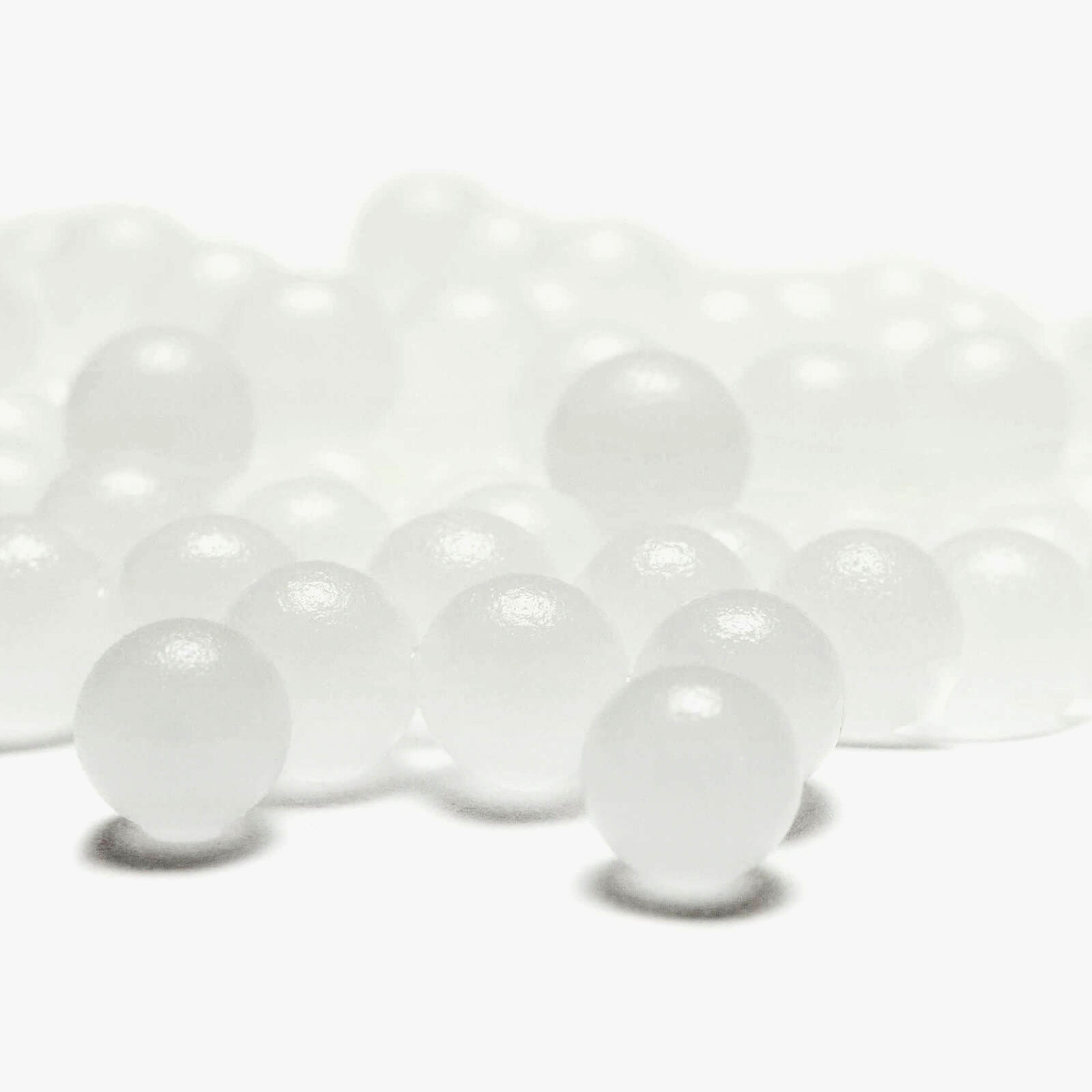
Can Orbeez save the Greenland ice sheet?
Every summer, the ablation zone of the Greenland ice sheet loses meters of ice to melt. Could we slow it down by covering the surface with water-absorbing gel beads, the kind sold as toys under names like Orbeez?
It’s an unconventional idea, and scaling it up to an ice sheet would be a formidable challenge. But working out whether, where and why it could work is a great physics problem.
Superabsorbent hydrogels can swell to hundreds of times their dry mass. Spread on bare ice, a gel layer might reflect sunlight, insulate the surface, and cool itself by evaporation. Or it might do the opposite: a swollen gel is mostly water, so a layer of clear, water-filled spheres could absorb sunlight, act as tiny lenses, and speed up melt. Similar schemes have been proposed before. Spreading hollow glass microspheres on Arctic sea ice was later shown to darken the surface and accelerate melt rather than slow it.
For any cover to work, it has to win on several fronts at once:
- Albedo: it must be brighter than the melting ice surface it covers. Clear gel won’t do; it probably needs a scattering additive or a porous, bubbly structure.
- Insulation: it must reduce sensible heat transfer, letting its top surface warm above 0 °C and give heat back to the air rather than passing it to the ice.
- Latent heat: a moist gel surface could cool by evaporation in dry conditions, but gain heat by condensation in humid ones.
Key questions include:
- Under what conditions does a gel cover reduce melt, and when does it make things worse?
- Does the shape matter? How do loose beads compare to a net of gel strands or a conventional reflective blanket?
- What happens to the gel over a melt season of daily freeze–thaw cycles, snowfall, wind and meltwater?
- Could the cover be made from a biodegradable gel that lasts one summer and then disappears, rather than turning into microplastic?
- How much material would it take to cover the ablation zone, and how does that compare to global polymer production?
The project can be shaped to suit your interests. It can be a hands-on laboratory project, a modelling project, or a mix of both. A good place to start is simply to test it: put gel on ice under a lamp in a cold room and see what happens. From there, the project can go in many directions, for example:
- Surface energy balance modelling of ice covered by a gel layer.
- Optical properties of hydrogels: albedo, transmission and lensing.
- Laboratory experiments on melt rates and freeze–thaw ageing of gel covers.
- Comparing gel covers with the geotextile blankets already used on Alpine glaciers.
Relevant resources and background literature:
- Webster & Warren (2022): Regional geoengineering using tiny glass bubbles would accelerate the loss of Arctic sea ice. Earth’s Future.
- Huss et al. (2021) on the effect of glacier covers in Switzerland (WSL summary).
- The EPFL Glacier Stewardship Program, which is looking for biodegradable alternatives to plastic glacier covers.