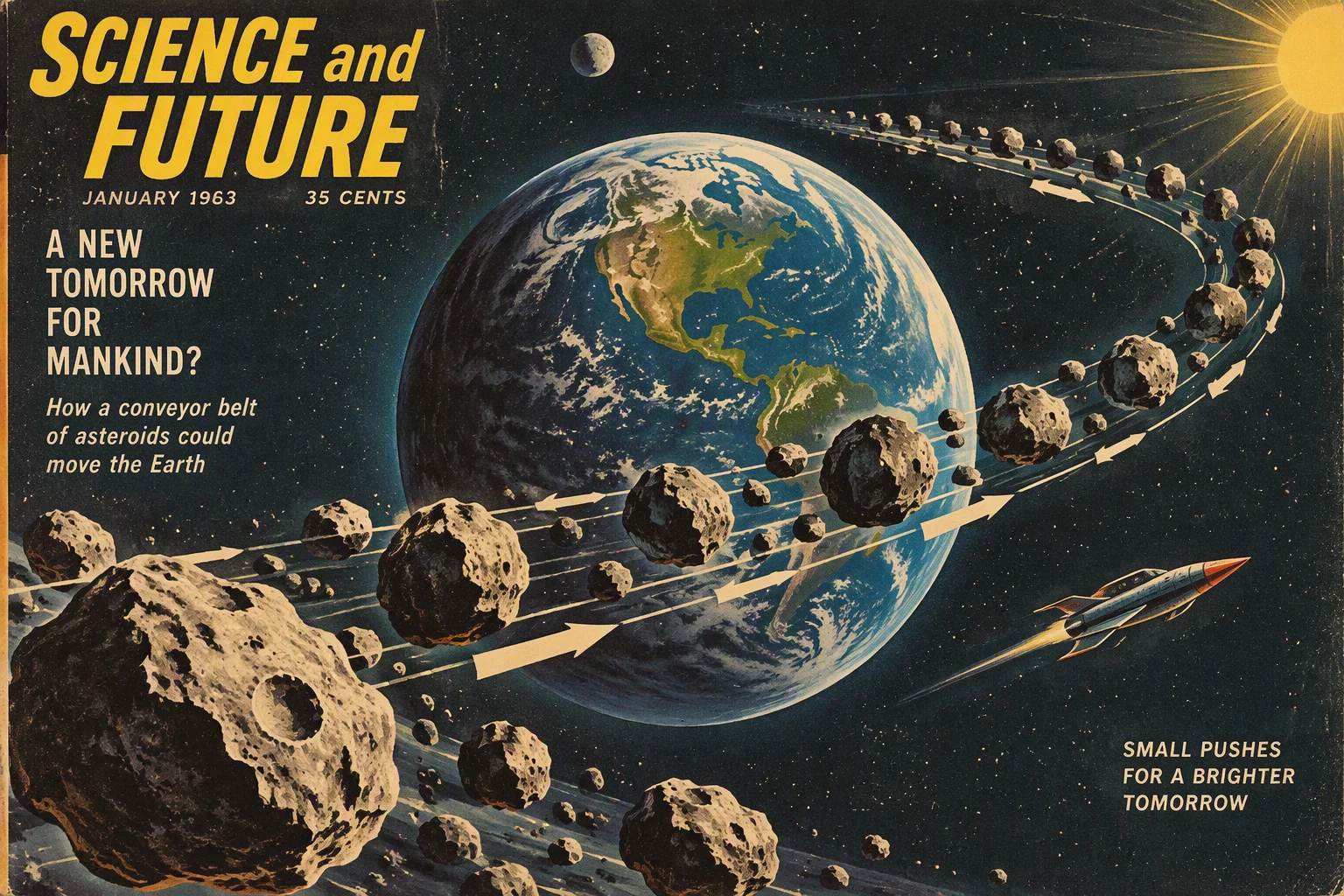
Can we move Earth?
As the Sun slowly becomes brighter over billions of years, Earth will eventually become too hot to remain habitable. One proposed far-future solution is to gradually move Earth to a larger orbit. Could this be achieved using a carefully designed sequence of asteroid flybys?
In this computational physics project, we will investigate whether repeated gravitational encounters between Earth and asteroids could transfer enough energy and angular momentum to increase Earth’s distance from the Sun by 1%. The project combines classical mechanics, orbital dynamics, and numerical modelling.
The idea was first proposed by Korycansky, Laughlin and Adams (2001), and reproducing their estimates from first principles is a natural starting point: how much asteroid mass is required, how often an encounter is needed, and where the energy ultimately comes from. From there, you can use numerical simulations to test the assumptions they had to make. How precise must each flyby be? What happens to the Moon? Can such an “asteroid conveyor belt” remain stable over many thousands of encounters?
Depending on your interests, the project may range from order-of-magnitude calculations to numerical simulations of asteroid encounters and orbital evolution. The emphasis is on first-principles estimates and on the constraints imposed by gravity and conservation laws, rather than on detailed mission design.
The ultimate goal is to answer a simple but fascinating question: could a sufficiently advanced civilization gradually move an entire planet?
Background:
- Korycansky, Laughlin and Adams (2001): the original proposal to move Earth using repeated asteroid flybys
- McInnes (2002): an alternative strategy using a giant solar sail
In fiction:
- The Wandering Earth by Liu Cixin (2000): humanity builds thousands of giant engines to push Earth out of the solar system, using a gravity assist from Jupiter along the way. It was later adapted into a blockbuster film.
- Thundering Worlds by Edmund Hamilton (1934): possibly the first story to move planets, with every planet in the solar system propelled to a new star to escape a dying Sun.