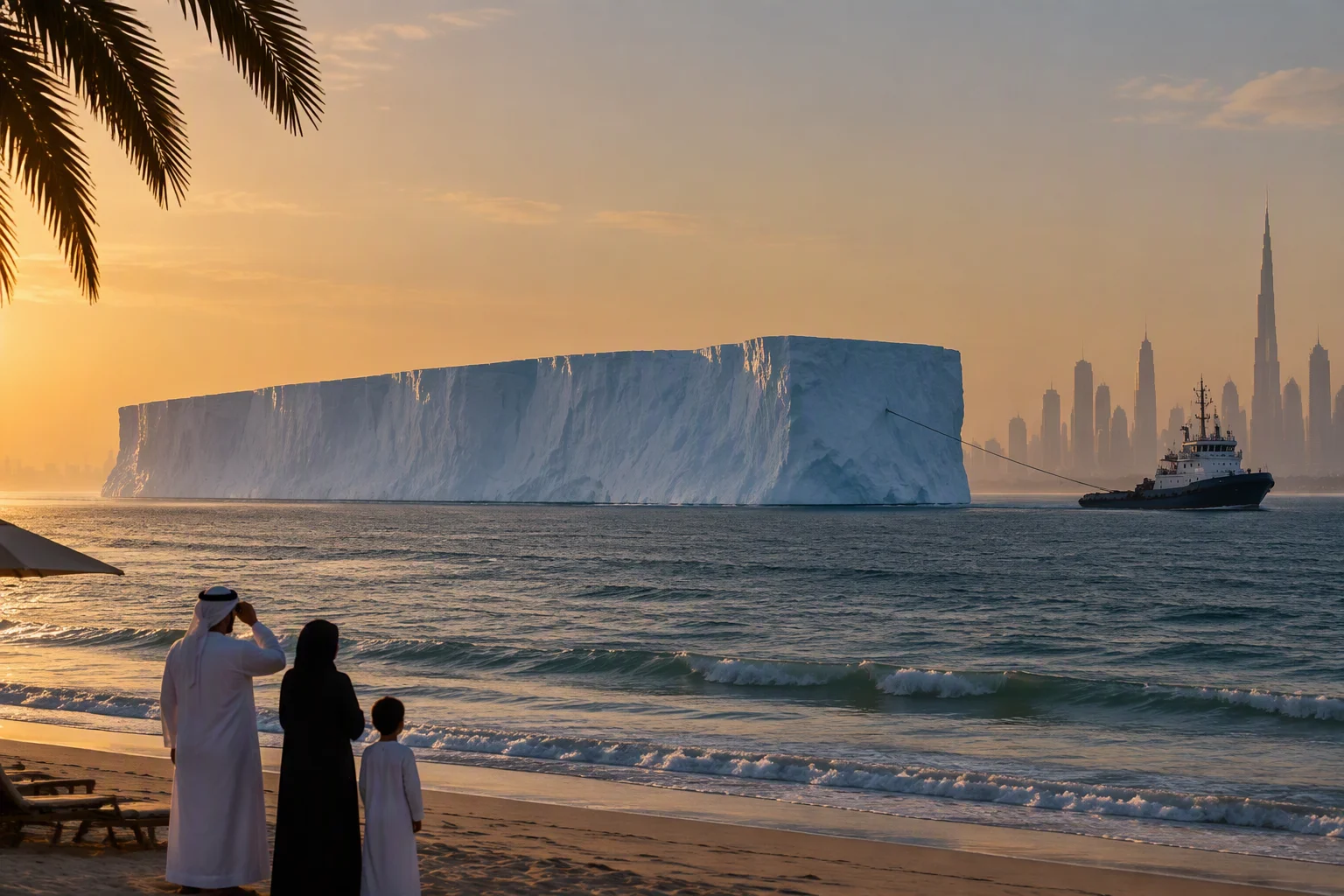
Can we tow an iceberg to Cape Town?
Towing Antarctic icebergs to drought-stricken cities has been proposed since the 1970s, most recently for Cape Town and the United Arab Emirates. It sounds crazy, but is it?
Could an iceberg survive the trip, and how much fresh water would actually arrive?
In this project, we will build a simple model of an iceberg’s energy budget during a long-distance tow, and use it to work out how big a berg must be to reach its destination. A central idea is to wrap the iceberg in a skirt that reaches deeper than its keel. Fresh meltwater is lighter than seawater, so it should collect inside the skirt as a cold, stable layer, shielding the ice from the warm ocean. Water that melts during the trip isn’t lost but simply stored. Does this turn a melting problem into a storage problem, and what does it cost in extra drag?
Depending on the student’s interests, the project may range from an energy-budget and scaling study, to a vertical column model of the trapped freshwater layer, to tank experiments with ice blocks, skirts and warm salty water. There is also room to look back at Project Habakkuk, the WWII plan to build an aircraft carrier out of insulated, refrigerated and reinforced ice, and ask whether any of those ideas could help a towed berg.
The ultimate goal is to give an honest, physics-based answer to whether iceberg towing could ever deliver water at a competitive price.
Curious? Look up: Condron (2023) “Towing icebergs to arid regions to reduce water scarcity”, Nick Sloane iceberg proposal, Project Habakkuk, …